Friday 15th November 2024 – Sunday 23rd February 2025
Jane Austen’s writing desk is now on display at God’s House Tower, where it remains until February 23, as part of region-wide events to celebrate her 250th birthday.
IN TRAINING FOR A HEROINE is one of the first Jane Austen 250 events happening to celebrate her birth, starting in November 2024.
The focus of the exhibition is Jane Austen’s writing slope, a travel writing desk that Jane took everywhere with her. On show at the aptly named God’s House Tower in Southampton, it is on loan from the British Library. It is the first time the desk has been back in the city since Jane Austen lived here 200 years ago, just a stone’s throw from where she lived at Castle Square.
The travel writing slope is in a special case in the middle of the room, which feels just like a Castle, and reminders of Jane’s writing of NorthangerAbbey is everywhere..
Jane Austen’s Travel Writing Slope is the treasure of the In Training for a Heroine Exhibition at God’s House Tower in Southampton
In Training for a Heroine told the story Jane Austen as a young, ambitious writer at the beginning of her career, the travelling writing desk symbolising a world of opportunity and possibility. Extracts from Jane Austen’s letters provide an insight into her life and her time in Southampton where she lived briefly in 1783 and from 1806-1809.
Dan Crow, Director of ‘a space’ arts, which manages God’s House Tower said: “We are thrilled to host the travelling writing desk and look forward to producing an exhibition that will launch a city-wide programme of events and activities to mark Jane’s 250th birthday.
Claire Whitaker, CEO of Southampton Forward, said: “This is a great opportunity for the city. The return of Jane Austen’s desk to Southampton marks the first in a series of events which celebrate ‘Jane Austen 250’, which is part of a regional programme. “These events will celebrate Jane Austen’s deep ties to Southampton, invite different perspectives of her life and literary works and explore her writing through a contemporary lens”.
Jane Austen’s Travel Writing Slope
Mr Austen purchased the slope for Jane’s 19th birthday in 1794. It is a portable, mahogany desk, sometimes called a ‘lap-desk’, was designed to fold into a case for ease of traveling. It has a secret drawer where Jane stored her most treasured possessions, including letters and manuscripts, and her money!
Jane Austen’s Travel Writing Slope on show.. you can see up close in this photograph the damage it has sustained over time..
Almost Lost
While traveling to Dartford in 1798, she nearly lost it when the slope was accidentally put onto a carriage which was on its way to Gravesend, and the West Indies! Jane told the dramatic story to Cassandra on 24 October 1798.
I should have begun my letter soon after our arrival but for a little adventure which prevented me. After we had been here a quarter of an hour it was discovered that my writing and dressing boxes had been by accident put into a chaise which was just packing off as we came in, and were driven away towards Gravesend in their way to the West Indies. No part of my property could have been such a prize before, for in my writing-box was all my worldly wealth. . . . Mr. Nottley immediately despatched a man and horse after the chaise, and in half an hour’s time I had the pleasure of being as rich as ever; they were got about two or three miles off.
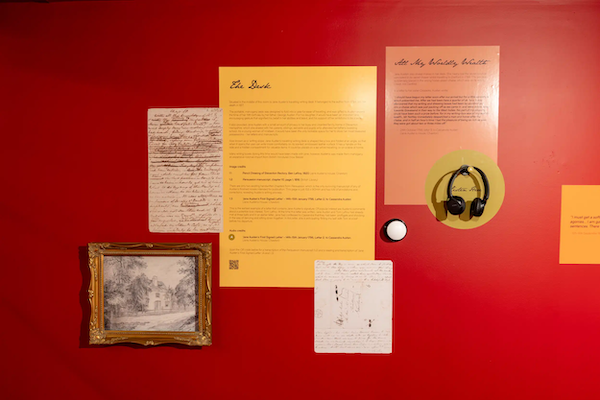
Letters, Sketches and Recorded Clips
Wall display of items relating to Jane Austen’s time in Southampton and the move to Chawton House, where the Austen ladies moved from here
God’s House Tower
Jane would have left town through God’s House Gate, at the south-eastern corner of the town’s walls. God’s House Gate is accessed from Winkle Street, inside the old walled town of Southampton. It was built in the thirteenth century and enlarged in the fourteenth, and allowed access in and out of the walled town, and led directly to Porter’s Meadow and the ferry that took her across the River Itchen.
God’s House Tower in Southampton, part of the original walls that were built to protect the city from French invasion during the Wars
TAGS: Jane Austen, Travel, Writing Slope, British Library, Letters, Regency era, Regency, Southampton, Birthday, 250th, Anniversary, Exhibition, Treasures, In Training for a Heroine.
See Jane’s Travel Writing Slope from all angles at the British Library.
The Memoir of my Aunt, Jane Austen, has been received with more favour than I had ventured to expect.
James Edward Austen-Leigh in the Preface to Memoir of Jane Austen
James Edward Austen, the son of Jane’s eldest brother James, was Jane’s fondest nephew. When he was 11 years old, he discovered from his school friends at Winchester College that his aunt was the author of two novels he had enjoyed. He was so delighted with the news that he penned a poem and sent it to her.
To Miss J. Austen
No words can express, my dear Aunt, my surprise Or make you conceive how I opened my eyes, Like a pig Butcher Pile has just struck with his knife, When I heard for the very first time in my life That I had the honour to have a relation Whose works were dispersed throughout the whole of the nation.
I assure you, however, I’m terribly glad; Oh dear! just to think (and the thought drives me mad) That you made the Middletons, Dashwoods, and all, And that you (not young Ferrars) found out that a ball May be given in cottages never so small. And though Mr. Collins, so grateful for all, Will Lady de Bourgh his dear Patroness call, ‘Tis to your ingenuity he really owed His living, his wife, and his humble abode.
It was Edward to whom Jane wrote letters to in the last months of her life, comforting him, and reassuring him that she would be well.
James Edward Austen Leigh as a young man (Jane Austen’s fondest nephew and son of her eldest brother James) (Public Domain)
After her death, it was Edward that wrote A Memoir of Jane Austen that contained pieces of stories, poems and letters she wrote. It received mixed reviews from the family and the public, however, as Jane’s popularity has grown, so has the popularity of her Memoirs.
A Memoir Of Jane Austen By James Edward Austen Leigh first produced in 1870 (Public Domain)
Emma Woodhouse, handsome, clever, and rich, with a comfortable home and happy disposition, seemed to unite some of the best blessings of existence; and had lived nearly twenty-one years in the world with very little to distress or vex her.
Jane Austen, Emma
So begins Jane Austen’s novel Emma, the last to be published in her lifetime. It is the only novel by Jane named after its heroine, and the only heroine who is under no pressure to marry.
So Emma has everything. She is intelligent, beautiful, and the youngest and fondest daughter of a wealthy father who indulges her every whim. The only person who ever expresses any criticism of Emma is Mr Knightley, who owns the nearby Donwell Abbey and estate.. and you can guess the rest.
Unlike Jane’s other heroines who need to marry for status or money, Emma is only concerned about boredom (the word used by some critics upon its publication).
Despite this, Emma as a heroine is usually voted second only to Elizabeth in PrideandPrejudice. Emma appeared on the 23 December 1815 and sold the most copies of any of Jane’s novels at that time, and has only been surpassed by Pride and Prejudice in recent years.
1. EMMA WAS WRITTEN IN ITS ENTIRETY WHILST JANE LIVED AT CHAWTON
According to Cassandra, Jane started writing Emma on 21 January 1814 and finished it on 29 March 1815. She was then 39 years old.
Unlike three of Jane’s earlier novels which she started writing in her teens (Sense and Sensibility, Pride and Prejudice and Northanger Abbey), Jane wrote Emma in its entirety whilst living at Chawton Cottage. She started writing it once Mansfield Park was published and sold out which must have spurred her on!
2. JANE HAD DECIDED THAT EMMA WAS NO ELIZABETH BENNET!
Whilst Jane had described Elizabeth Bennet, ‘as delightful a creature as ever appeared in print’, she had told Cassandra that she was going to write about someone less perfect. ‘I am going to take a heroine whom no one but myself will much like.’
As it turned out, many Jane Austen fans love her Emma and she is one of Jane’s most popular characters.
3. JANE REFERRED TO HER NOVELS AS HER CHILDREN
Jane referred to her novels as her own children, and had called Pride and Prejudice her ‘Own darling child’. She wrote in a letter to her niece Anna in 1815 (whose new daughter she had not yet seen), ‘As I wish very much to see your Jemima, I am sure you will like to see my Emma.’
4. EMMA WAS THE ONLY HEROINE IN JANE’S NOVELS THAT WAS NOT UNDER PRESSURE TO MARRY
Jane wrote the opening line of the novel, ‘Emma Woodhouse, handsome, clever, and rich, with a comfortable home and happy disposition ..and had lived nearly twenty-one years in the world with very little to distress or vex her.’ Emma is the only heroine of Jane’s that is not under pressure to marry – for love, security or status.
Gwyneth Paltow As Emma Woodhouse in Jane Austen’s Emma
5. JANE WAS NEVER KNOWN AS THE AUTHOR OF EMMA OUTSIDE HER CLOSE FAMILY
Only Jane’s family and close friends knew Jane was the author of Mansfield Park, Sense and Sensibility and Pride and Prejudice. When Emma was published the title page simply reads, ‘By the Author of “Pride and Prejudice, etc etc’.
Although Emma went on sale on 23 December 1815, the title page reads 1816 as it was so close to end of the year.
6. JANE’S FAME INCREASED IN THE LAST TWO YEARS OF HER LIFE
It was clear that Jane’s fame was increasing as the dedication inside Emma is to the Prince Regent. Whilst Jane was in London nursing Henry through a serious illness, his doctor was a friend of the Prince Regent’s librarian James Stanier-Clarke, and it was he who made the introduction.
Although Jane disliked the Prince Regent who was known to gamble and have many mistresses, she must have been flattered that he admired her novels and had copies in each of his residences. She sent a specially bound copy to Carlton House for the future King which is now in the Royal Household in London.
7. JANE’S NOVEL EMMA WAS ADVERTISED IN THE NEWSPAPERS
Much to Jane’s delight, the Morning Chronicle announced the publication of Emma on 23 December 1815.
8. JANE WAS WORRIED AS MOST AUTHORS ARE ABOUT THE SUCCESS OF EMMA
In a letter to John Murray written on 11 December a few weeks before Emma was published, Jane shared her worries about the public reception of her new novel. ‘I am very strongly haunted by the idea that to those Readers who have preferred P&P. it will appear inferior in Wit, & to those who have preferred MP. very inferior in good Sense.’
In receiving feedback and reading the reviews, it seems that the literary critics of the day enjoyed Emma and wrote positive reviews. Sir Walter Scott wrote in the Quarterly Review that he thought Emma was part of a new trend in fiction, ‘Which has arisen almost in our own times, and which draws the characters and incidents introduced more immediately from the current of ordinary life than was permitted by the former rules of the novel.‘
9. JANE MADE THE LEAST AMOUNT OF MONEY FROM EMMA ALTHOUGH IT WAS HER MOST SUCCESSFUL
Written in 1814, Emma was ready in March 1815. Egerton was Jane’s previous publisher and he delayed publishing whilst he negotiated with Murray, another successful publisher. John Murray was a prominent London publisher of many famous authors and The Quarterly Review, which Jane read and admired which may be why she chose him.
They eventually agreed that Jane would publish at her own expense and as the first editions of her previous novels had sold out, it was decided to print 2,000 copies of Emma. Murray received 10% of the profits and Egerton made a healthy £450 (around $600 USD) from this transaction.
The accounts show that Jane made much less at £222 (around $300 USD) from the initial sales. After the reprint of Mansfield Park was deducted, her royalties were £40 (around $55 USD) which she received in February 1817.
Although Emma was Jane’s most successful novel in the way of sales, it made her the least money.
10. JANE SHOWS YOU CAN BE HAPPY BEING SINGLE
Jane shows that you can be happy being single and marriage is not the key to happiness. (As long as you have a wealthy father, lots of shopping trips, great friends that forgive you, and a warm fire!).
Find Emma themed events on our Events page, including a monthly themed walk around London or join a walk and talk in Chawton to hear about Jane’s second most popular heroine.
I sincerely hope your Christmas… may abound in the gaieties which the season generally brings.
Christmas was a special time for Jane. December was the month of her birthday after all, which fell on the 16th in the middle of the Christmas celebrations.
All of Jane’s family and friends came together, so it was a time of celebration, balls, parties, masquerades, play acting, games and lots of food. Jane also gave gifts to the poorer members of the parish as she mentions in her letters to Cassandra.
It was a longer season than we have now, and stretched from Saint Nicholas Day on 6 December to 6 January, Twelfth Night, Epiphany, and sometimes far past this date as Jane stayed with her brothers or with friends for weeks at a time.
Since families and friends were already gathered together, it was also a time for weddings, which were often shared with other couples at the same service. As a girl, Jane was often asked to stand in as a witness, and you can see her name written in the Steventon Marriage Register.
Jane’s brother Edward married Elizabeth Bridges on Boxing Day 1791, at a lavish double wedding with her sister in Kent. Henry married their cousin Eliza on 31 December 1797 in London, no doubt inspiring the romantic endings Jane writes of in her novels.
On Christmas Day itself, Jane and her family went to Church, and whilst living at Steventon, Jane’s father Reverend George Austen would deliver the sermon. This was followed by carols and special prayers.
The congregation would have sung the same Christmas carols we sing today, including God Rest Ye Merry Gentlemen written in the 13th century and published in a carol book in 1760, and The First Noel, which was actually French and written in the 14th century.
Steventon Church Christmas
The prayers said at Christmas were from the Book of Common Prayer, the same prayer book Jane’s family used.
O God, You make us glad by the yearly festival of the birth of your only Son Jesus Christ: Grant that we, who joyfully receive him as our Redeemer, may with sure confidence behold him when he comes to be our Judge; who lives and reigns with you and the Holy Spirit, one God, now and forever. Amen.
On returning home, the rectory was decorated with foliage, such as bay leaves and cuttings from holly bushes, trees and rosemary. It was traditional to exchange gifts marking the first day of the Christmas season. Food was plentiful and usually a goose or turkey was eaten followed by plum pudding, that would be cooked together with the villagers in the bake house.
Chawton House Christmas
The day after Christmas, Saint Stephen’s Day, was the day when people gave to charity and servants were presented with Christmas Boxes by their employers. This is why Saint Stephen’s Day is called Boxing Day today.
It was such a special time for Jane that she mentions Christmas in all her novels. John Willoughby dances from eight o’clock until four in the morning in Sense and Sensibility. In Mansfield Park, Sir Thomas gives a ball for William and Fanny at Christmas time. In Northanger Abbey, Catherine worries about what ‘gown and what head-dress she should wear’ because ‘her great aunt had read her a lecture on the subject only the Christmas before.’
The Bennets play host to their family in Pride and Prejudice, and Caroline writes to Jane saying, ‘I sincerely hope your Christmas … may abound in the gaieties which that season generally brings.’ In Pride and Prejudice, Charlotte Lucas marries, and Elizabeth writes to her aunt Gardiner, ‘You are all to come to Pemberley at Christmas.’
In Emma, Mr. Elton says, ‘This is quite the season indeed for friendly meetings. At Christmas every body invites their friends about them.’ Just as we look forward to seeing family and friends at Christmas, Emma is looking forward to a visit from her sister and her family. ‘Many a long October and November evening must be struggled through at Hartfield, before Christmas brought the next visit from Isabella and her husband, and their little children, to fill the house, and give her pleasant society again.’
In Persuasion, Jane gives us a perfect image of a happy Christmas day. ‘On one side was a table occupied by some chattering girls, cutting up silk and gold paper; and on the other were tressels and trays, bending under the weight of brawn and cold pies, where riotous boys were holding high revel; the whole completed by a roaring Christmas fire, which seemed determined to be heard, in spite of all the noise of the others. Charles and Mary also came in, of course, during their visit, and Mr Musgrove made a point of paying his respects to Lady Russell, and sat down close to her for ten minutes, talking with a very raised voice, but from the clamour of the children on his knees, generally in vain. It was a fine family-piece.‘
All of these events give us a wonderful insight into Jane’s Christmas season.
Christmas Letters to Cassandra
In a Christmas Eve letter to Cassandra, Jane says that she enjoyed a ball held that week and lists her charitable giving of what to whom. Many of Jane’s plays written for the family survive, and in 1787 the children staged a full length production which included cousins and friends.
Jane wrote to Cassandra on 7 January 1807. ‘When you receive this our guests will all be gone or going; and I shall be left to the comfortable disposal of my time, to ease of mind from the torments of rice puddings and apple dumplings, and probably to regret that I did not take more pains to please them all.’
As Jane would say at the end of her letters, ‘I wish you a cheerful and at times even a Merry Christmas.’
My real purpose was to see you, and to judge, if I could, whether I might ever hope to make you love me.
Mr Darcy, Pride and Prejudice
This is one of the most famous lines side by Mr Darcy in Jane Austen’s most successful novel PrideandPrejudice.
Jane Austen had a clever way of writing her characters as she demonstrates with Mr Darcy. As a reader, you share Elizabeth’s initial sentiment that he is pompous and unkind, and in total contrast to his friend Charles Bingley. By the end of the novel, you agree with Elizabeth that he is actually compassionate and generous as he helps her sister Lidia avoid a scandal with Wickham.
Jane does give us hints along the way to her own measure of the man. ‘Mr Darcy they had only seen in church‘ demonstrates how religious Mr Darcy is ( a tick in Jane’s box), and if he was at church on this day, he would have been there twice as it was Good Friday.
Jane’s Mr Darcy is very rich
Mr Darcy’s fortune was around £10,000 a year, which makes him a modern day multi-millionaire and then some. No wonder Mrs Bennet cries with joy, ‘I can think of nothing else! Ten thousand a year and very likely more! ’Tis as good as a Lord!’
To reaffirm this wealth and superiority, Jane cleverly chose the name ‘Fitzwilliam Darcy’ for her hero. Readers would have been familiar with the wealthy Fitzwilliam family whose property was twice the size of Buckingham Palace. They would have also known the ’Darcy’ name in the form of ‘D’Arcy’ meaning ‘ofArcy’ in French.
It was brought over by the Normans when William the Conqueror invaded England in 1066. This lineage was very wealthy and had what we would term old money.
Jane Austen’s Own Mr Darcy
People like to think that Jane based Mr Darcy on Tom Lefroy, a man she met at her friends house one Christmas. She fell in love, although her status and lack of fortune meant it would never be a match, and he was sent away to continue his studies, marrying a short time later he moved back to Ireland.
First Impressions
Fourteen years later in 1811, Jane began revising First Impressions which was finally published as Pride and Prejudice on 28 January 1813. Jane wrote of her excitement in a letter to Cassandra, ‘my own darling Child has arrived from London.’ Miss Benn lived a few cottages away in Chawton village, and as she was so poor, the Austen ladies often invited her to tea. They read the novel aloud and Miss Benn never knew that Jane was the author.
The novel sold so well a second edition was printed in the Autumn of the same year, and a third in 1817. The reading public adored Elizabeth Bennet and it was a huge success.
Jane was a great believer in love and marriage, even though she never married herself. To her niece Fanny she wrote, “To you I shall say, as I have often said before, do not be in a hurry, the right man will come at last.”
A modern Mr Darcy
Mr Darcy at Hyde Park in the Serpentine Gallery
Jane spent a lot of time walking in Hyde Park and along the banks of the Serpentine in London when visiting her brother Henry, which is where a 12-foot Mr Darcy was placed.
It was to celebrate the 1995 version of Pride and Prejudice featuring Colin Firth as Mr Darcy, in the most popular version of Jane’s novel. Written by Andrew Davies (of recent Sanditon fame) it sold 100,000 video box sets whilst on air, and 10 million people watched the final episode. People are amazed to discover that the lake scene where Darcy takes a dip before striding away in his clinging wet shirt and bumping into his future bride is not in the book.
The filming took six months, and Colin fell in love with his co-star Elizabeth, played by Jennifer Ehle.
The fibre glass statue has been moved to Lyme Park in Cheshire where most of the TV series was filmed.
Delicious Mr Darcy
To celebrate 25 years of the BBC’s adaptation of Jane Austen’s most popular novel, Pride and Prejudice, a 6ft cake was unveiled to the public at National Trust property Lyme Park in Cheshire, of Colin Firth fame. Michelle Wibowo, worked on the creation of Darcy’s cake counterpart; a process which took over 200 hours.
Nobody was keen on eating him, and he had to laid down and packaged into small, bite-sized pieces!
The other Mr Darcy
In the film edition of Pride and Prejudice, the role of Mr Darcy was played by Matthew Macfayden. He played alongside Keira Knightley as Elizabeth, and the film has been a great success. To celebrate, a bust of Matthew as Mr Darcy is presented in the hallway of Chatsworth House, often used as a film location and some say as inspiration for Pemberley.
A Real Looker
So what did Mr Darcy look like? A special FBI profiler created an image of Mr Darcy from descriptions and research. He produced this image, which some say makes Mr Darcy look too old, however, his hair is probably powdered as was the fashion in the regency period.
“Under Mrs Rushworth’s guidance were shown through a number of rooms, all lofty, and many large, and amply furnished in the taste of fifty years back, with shining floors, solid mahogany, rich damask, marble, gilding, and carving, each handsome in its way.
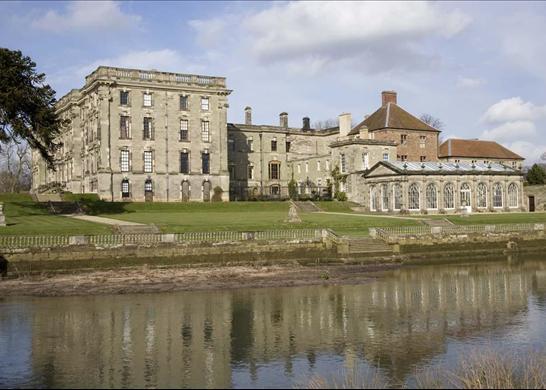
Stoneleigh Abbey in Warwickshire offers a compelling journey into the world that inspired one of Jane’s most impressive houses, Sotherton in Mansfield Park.
This splendid estate, situated beside the tranquil River Avon, and invites visitors to step back in time and experience the elegance and serenity that shaped Jane’s literary imagination.
For over four centuries, Stoneleigh Abbey was the residence of Jane Austen’s maternal relatives, the distinguished Leigh family. Jane’s mother, Cassandra Leigh, was related to the Brydges family (Dukes of Chandos), a family with notable titles and wealthy estates in Warwickshire. Her father was one of thirteen children, so there were many cousins and distant relations to inherit, as usual by male family members.
In August 1806, Jane, along with her sister and mother, stayed at the Abbey. They made the journey from Adlestrop Rectory with Mrs Austen’s cousin, Reverend Thomas Leigh. The news of Mary Leigh’s death had revealed news of a potential inheritance.
This prompted Reverend Thomas to consider claiming the estate, and he invited the Austen ladies to accompany him.
Jane would have arrived at Stoneleigh in a carriage, driven down the long lane with large oak trees planted evenly down either side. She passed through the arched gate to come upon the grandeur of the large house with its 46 windows facing the evening sun.
Flanked by the River Avon and surrounded by fields and forests as far as the eye could see, it’s an impressive sight.
Stoneleigh Abbey with its Orangery overlooking the River Avon
Inside, the layout of the house and furniture would have looked similar and reflected the family’s wealth. A large ballroom overlooks the lawn where balls were held and many rooms for guests to stay in. The library in a wing of the house is large and cosy, and is one of the most special rooms in the house.
It must have been easy to get lost inside, as Mrs Austen noted in a letter, ‘The house is larger than I could have supposed. We cannot find our way about it.’
Stoneleigh Abbey Library
As the ladies became more comfortable, Jane began with prayers each morning in the handsome chapel, an experience that would later influence her writing of Mansfield Park.
Fanny’s imagination had prepared her for something grander than a mere spacious, oblong room, fitted up for the purpose of devotion: with nothing more striking or more solemn than the profusion of mahogany, and the crimson velvet cushions appearing over the ledge of the family gallery above.
Stoneleigh Abbey Private Family Chapel
Their visit also impressed Mrs Austen. She wrote a long letter to her sister-in-law Mary where she touches on praying in the chapel, and then talks a lot more about the sumptuous food for breakfast!
We say our prayers in a handsome chapel, of which the pulpit is now hung with black. Then follows breakfast, consisting of chocolate, coffee, and tea, plum cake, pound cake, hot rolls, cold rolls, bread and butter, and dry toast for me.
Jane Austen’s Visit
The wonderful thing about visiting Stoneleigh is that Jane stayed here for a time and wrote it into her novel Mansfield Park. In the novel, the party visit Sotherton and give their opinions about the private chapel with the same crimson velvet cushions.
Jane rarely used real places and people, which shows the impact Stoneleigh had on her. It must have been a shock to discover that her mother’s relations were very wealthy and lived in huge houses such as Stoneleigh.
The timing of this visit was poignant. It came after the death of Jane’s father, when the Austen ladies had left Bath and were on their way to Southampton to share a home with Frank and his wife Mary. In Jane’s commentary in Mansfield Park, she gives the view that people say they follow God’s work, though do not act in a charitable way.
A Difficult Inheritance
There were two lines of inheritance from Mary Leigh’s will. One family member inherited Adlestrop and its lands, and the other Stoneleigh and its lands which was much more valuable. Mar y Leigh lived at the estate until she died as the male line of the family had died out.
There were three claimants, Rev Thomas Leigh who Mrs Austen and Jane accompanied, his nephew James Henry Leigh, squire of Adlestrop, and James Leigh Perrot (Jane’s uncle from Bath). Rev Thomas Leigh’s won his claim, and left Stoneleigh in trust to pass to his nephew upon his death. It was hoped that Mrs Austen would inherit something from her cousin, however, this seems not to have happened.
Jane must have felt it unjust that her mother, Mrs Austen, had to leave her relatives at Stoneleigh with no inheritance at all, and live with limited means without Mr Austen’s pension with her son and his wife.
Your Visit
Today, you can visit Stoneleigh Abbey on a timed tour with a guide. You can buy this in advance on the website or when you arrive. During the tour of house you will see many family portraits and Mrs Austen’s family tree. You will also visit to the family chapel, where the rich crimson velvet cushions and elegant mahogany details are as Jane described, offering a timeless link into her world.
The Orangery on the far side of the house is now a cafe, with beautiful views over the river and surrounding countryside. This is a lovely place to enjoy a cup of tea and cake whilst waiting or when you have finished your tour.
Planning Your Journey
Stoneleigh is in the county of Warwickshire, just southeast of Birmingham. Unfortunately, the beautiful village of Stoneleigh with its thatched cottages is affected by construction of the failed HS2 rail project. There are many roadworks, hills being dug into, and roads closed. I was genuinely shocked, so please check your route before you set out and follow the detour signs. The old village is worth seeing, as it’s so quintessentially English and even has a Community Orchard.
Mrs Austen’s Letter to Mary (her daughter-in-law.) dated 13 August 1806
MY DEAR MARY, – The very day after I wrote you my last letter, Mr Hill wrote his intention of being at Adlestrop with Mrs Hill on Monday, the 4th, and his wish that Mr Leigh and family should return with him to Stoneleigh the following day, as there was much business for the executors awaiting them at the Abbey, and he was hurried for time. All this accordingly took place, and here we found ourselves on Tuesday (that is yesterday night) eating fish, venison, and all manner of good things, in a large and noble parlour, hung round with family portraits.
The house is larger than I could have supposed. We cannot find our way about it – I mean the best part; as to the offices, which were the Abbey, Mr. Leigh almost despairs of ever finding his way about them. I have proposed his setting up direction posts at the angles. I had expected to find everything about the place very fine and all that, but I had no idea of its being so beautiful. I had pictured to myself long avenues, dark rookeries, and dismal yew trees, but here are no such dismal things. The Avon runs near the house, amidst green meadows, bounded by large and beautiful woods, full of delightful walks.
“At nine in the morning we say our prayers in a handsome chapel, of which the pulpit, &c. &c., is now hung with black. Then follows breakfast, consisting of chocolate, coffee, and tea, plum cake, pound cake, hot rolls, cold rolls, bread and butter, and dry toast for me. The house steward, a fine, large, respectable-looking man, orders all these matters. Mr. Leigh and Mr. Hill are busy a great part of the morning. We walk a good deal, for the woods are impenetrable to the sun, even in the middle of an August day. I do not fail to spend some part of every day in the kitchen garden, where the quantity of small fruit exceeds anything you can form an idea of. This large family, with the assistance of a great many blackbirds and thrushes, cannot prevent it from rotting on the trees. The gardens contain four acres and a half. The ponds supply excellent fish, the park excellent venison; there is great quantity of rabbits, pigeons, and all sorts of poultry. There is a delightful dairy, where is made butter, good Warwickshire cheese and cream ditto. One manservant is called the baker, and does nothing but brew and bake. The number of casks in the strong-beer cellar is beyond imagination; those in the small-beer cellar bear no proportion, though, by the bye, the small beer might be called ale without misnomer. This is an odd sort of letter. I write just as things come into my head, a bit now and a bit then.
Now I wish to give you some idea of the inside of this vast house – first premising that there are forty-five windows in front, which is quite straight, with a flat roof, fifteen in a row. You go up a considerable flight of steps to the door, for some of the offices are underground, and enter a large hall. On the right hand is the dining-room and within that the breakfast-room, where we generally sit; and reason good, ’tis the only room besides the chapel, which looks towards the view. On the left hand of the hall is the best drawing-room and within a smaller one. These rooms are rather gloomy with brown wainscot and dark crimson furniture, so we never use them except to walk through to the old picture gallery. Behind the smaller drawing-room is the state-bedchamber – an alarming apartment, with its high, dark crimson velvet bed, just fit for an heroine. The old gallery opens into it. Behind the hall and parlours there is a passage all across the house, three staircases and two small sitting-rooms. There are twenty-six bedchambers in the new part of the house and a great many, some very good ones, in the old.
There is also another gallery, fitted up with modern prints on a buff paper, and a large billiard-room. Every part of the house and offices is kept so clean, that were you to cut your finger I do not think you could find a cobweb to wrap it up in. I need not have written this long letter, for I have a presentiment that if these good people live until next year you will see it all with your own eyes.
Our visit has been a most pleasant one. We all seem in good humour, disposed to be pleased and endeavouring to be agreeable, and I hope we succeed. Poor Lady Saye and Sele, to be sure, is rather tormenting, though sometimes amusing, and affords Jane many a good laugh, but she fatigues me sadly on the whole. To-morrow we depart. We have seen the remains of Kenilworth, which afforded us much entertainment, and I expect still more from the sight of Warwick Castle, which we are going to see to-day. The Hills are gone, and my cousin, George Cook, is come. A Mr. Holt Leigh was here yesterday and gave us all franks. He is member for, and lives at, Wigan in Lancashire, and is a great friend of young Mr. Leigh’s, and I believe a distant cousin. He is a single man on the wrong side of forty, chatty and well-bred and has a large estate. There are so many legacies to pay and so many demands that I do not think Mr. Leigh will find that he has more money than he knows what to do with this year, whatever he may do next. The funeral expenses, proving the will, and putting the servants in both houses in mourning must come to a considerable sum; there were eighteen men servants.